
Preparing for a Shrimad Bhagwat Katha at home
Published: 26 July 2026 · Acharya Krishna Kant Shrimukh Shandilya Ji Maharaj · 10 min read
A Shrimad Bhagwat Katha at home is a recitation of the Bhagwat Puran, spoken and explained by a katha vachak seated on a Vyas Peeth in the host family's house, courtyard, terrace or a hall taken for the purpose. It is most often held as a Saptah — seven days, with the Bhagwat Puran recited in sequence from the first skandha to the twelfth, and the Katha concluded on the seventh day with a havan and bhandara. Each day runs three to four hours, the host takes a sankalp on the first morning before the recitation begins, and prasad is distributed at the close of every session. Shorter forms exist and are entirely proper: a three-day Katha, or a single-day recitation of the tenth skandha, are commonly arranged where seven days are not possible.
How many days a Bhagwat Katha takes
The Puran has twelve skandhas and the Saptah seven days, so no day maps onto one skandha. Vachaks divide it a little differently; the shape below is the usual one. Ask at the time of booking which day the Janmotsav and Rukmini vivah fall on — those two draw far more people than the rest, and seating, prasad and parking all follow from knowing which they are.
What each of the seven days covers
- Day one — the Mahatmya, sankalp and Vyas pujan, then the first skandha: Naimisharanya, and Parikshit's curse.
- Day two — second and third skandhas: Shukdev ji's arrival, creation, Kapil ji and Devahuti.
- Day three — fourth skandha: Dhruv, Prithu, the Daksha yajna. A quiet day, usually the week's thinnest attendance.
- Day four — fifth to seventh skandhas: Ajamil, Vritrasur, Prahlad and the appearance of Narasimha.
- Day five — eighth skandha into the tenth: Gajendra moksha, samudra manthan, Vaman, then Krishna Janma, kept as a Nand Utsav in the room.
- Day six — the tenth skandha at length: Gokul and Vrindavan, Govardhan and chhappan bhog, Mathura, Rukmini vivah.
- Day seven — eleventh and twelfth: Sudama charitra, Parikshit's release, vishram, then the havan, the last aarti and the bhandara.
The three-day and one-day Katha
A three-day Katha carries the same arc compressed — the opening and creation, the bhakt charitras up to Prahlad, then the tenth skandha with the closing ones. Families choose it when leave, a rented hall or an elder's health rules out seven days. The one-day form is usually the dashm skandha alone, and is the common choice for a birthday, a naming, a griha pravesh or a vow completed. It is not a lesser Katha but a different niyam, and better than a Saptah the family cannot sit through.
Choosing the dates
Dates are chosen first. The tradition avoids the intercalary and inauspicious periods and prefers the months associated with the text, but in practice the decision balances the panchang against when the family can actually gather. It is better to hold a Katha the family attends than to hold it on a technically superior date that half of them miss.
Malmas is left out for a new auspicious undertaking, and ashaucha in the house — a birth or a death in the immediate family — holds the sankalp back until those days are complete. Pitru Paksha is a separate matter: a Katha for someone who has died may deliberately be held then, while a celebratory one is set outside it. Bring two or three workable windows rather than one fixed date; a tithi is nearly always available inside a window, and rarely on a day already decided.
The sankalp — who takes it and what is said
The sankalp is the formal statement of intent, taken on the first morning after the kalash sthapan and Vyas pujan, before the recitation begins, with water, akshat and a flower in the hand. It names the place and the time in full — samvatsar, ayan, ritu, maas, paksha, tithi and vaar — then the gotra and the names of those taking it, then the purpose: a wish, a vow being completed, or the shanti of someone who has died.
The yajman and his wife usually take it together and sit through all seven days, keeping a niyam of restraint in food and of not leaving mid-session; settle what that niyam is before the first day. Where the person in whose name the Katha is held cannot sit, another family member may take it on their behalf — ask how, rather than deciding it on the morning.
The Vyas Peeth
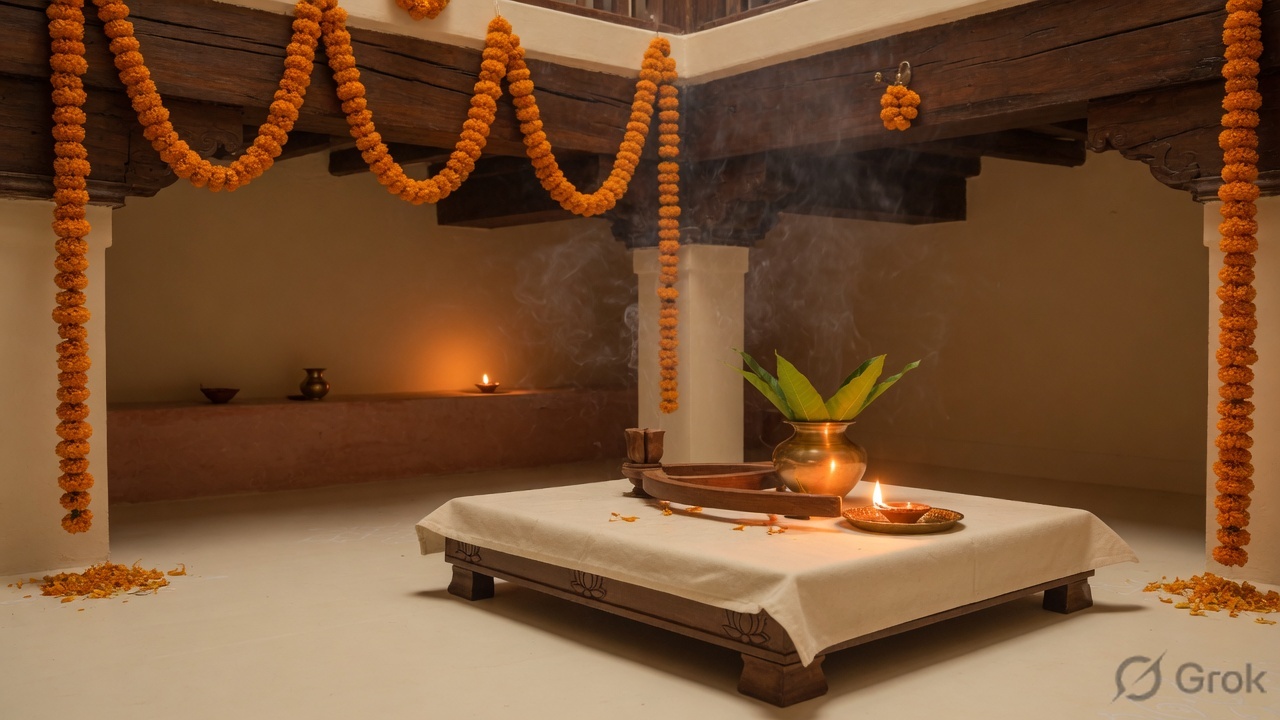
The Vyas Peeth is the seat from which the Katha is spoken, and it is treated as the seat of Vyas rather than as furniture. It is raised, faces east or north, and is kept clean and undisturbed for the duration. The Bhagwat Puran is placed on it and worshipped before the recitation each day. A low platform, a clean cloth and a cushion are sufficient; the arrangement should be simple and well kept rather than elaborate.
In practice the platform stands a foot and a half to two feet off the floor — high enough for the back row to see and hear, low enough that the vachak is not speaking down at people a few feet away. The pothi rests on its own stand to his right, on clean cloth, never on the floor, and is wrapped when the session ends. A kalash of water, mango leaves and coconut is established beside the Peeth on the first day and stays there; if an akhand deep is lit, give one person that single job.
What is enough, and what is over-decoration
- Enough: a clean chowki, fresh cloth, a fresh garland daily, a canopy if the Peeth is outdoors, and light bright enough to read the pothi by.
- Too much: a flower backdrop that stops the air, an arch that hides the vachak from the side rows, coloured lights that heat a closed room, a platform so high the elders cannot see him.
Seating, sound and the four hours
For the listeners, plan seating on the floor with clean sheets, leaving a clear aisle to the Peeth, and keep the elderly in mind — a few chairs at the back are sensible and take nothing away from the occasion. Each day runs three to four hours, usually in the afternoon or evening, and closes with aarti and prasad distribution.
Keep that aisle clear, about three feet — the aarti thali, the prasad and the vachak all move along it, and by the fifth day it is where bags collect. Chairs belong at the back or along a side wall, never mid-room. One mic on the Peeth with two small side speakers carries better than a single loud speaker at the front; set it for speech and test it with the room full. Fans should blow across the room, not at the Peeth: aimed there they turn the pages, kill the deep and hum into the mic. The room fills late, so leave the rows by the door loose, and keep a mat in a back corner for the children.
What to prepare — the samagri
Ask for a written list at the time of booking, and ask which items the karmakandi brings and which the household arranges. That one question prevents most of the last-minute running about.
- The pothi and its stand; the chowki for the Peeth; clean cloth for both; an asan for the vachak.
- Kalash, coconut, mango leaves, moli, akshat, roli, haldi, chandan.
- Ghee, cotton wicks, deep, dhoop, agarbatti and camphor — with enough ghee for an akhand deep if one is kept.
- Panchamrit: milk, curd, ghee, honey, sugar; tulsi kept fresh daily.
- Flowers and a garland for the pothi every day — a daily purchase, not a one-time one.
- Supari, elaichi, laung, dry fruit, gur, jau and til; havan samagri and mango wood for the last day.
- Aarti thali, ghanti, shankh; daris, sheets, chairs, microphone, fans, drinking water.
Prasad each day and the closing bhandara
Prasad is prepared fresh each day, satvik and without onion or garlic. Panchamrit, tulsi, fruit and a simple sweet are the usual offering; on the concluding day the bhandara is larger. Two days want more than the usual: Krishna Janma, where sweets, a small cradle and dhaniya panjiri are customary, and the Govardhan prasang, where families keeping the custom offer a chhappan bhog — many small items, not an expensive spread.
For the bhandara, count on more people than came on any earlier day; word travels through the week. Fix beforehand where the pangat sits, who serves, and where used pattals go — the last of those is what turns a good bhandara into a mess.
The arrangements families forget
Practical arrangements matter more than people expect — where guests will leave footwear, where prasad will be prepared, whether the room stays cool for four hours. Settle these before the first day and the seven days run themselves.
- Footwear — a spot away from the doorway, a mat, one person responsible. By the seventh day it needs three times the space you allowed.
- Kitchen — keep the prasad cooking separate, with its own vessels for those days.
- Power — add up the fans, lights and mic beforehand and keep a backup for the mic. A power cut should not stop the recitation.
- Parking — ask the neighbours in advance, and keep the lane passable; an ambulance must get through.
- Where guests wait — there is a crowd before each session and after aarti. Give it somewhere to stand that is not the aisle.
What to decide before you ask for dates
- Seven days, three days or one.
- The venue, and honestly how many it seats.
- Which two people take the sankalp and sit through the Katha.
- Two or three date windows, not a single date.
- Whether the Katha is for an auspicious occasion or for the shanti of someone who has died — it changes the wording of the sankalp and the tone of the celebratory prasangs.
- Whether the bhandara is for the family or the whole neighbourhood. Everything else scales from that answer.
- One person in the family as the point of contact. Not four.
Questions families ask
What does a Bhagwat Katha at home cost?
There is no fixed figure, and anyone quoting one without knowing the details is guessing. It depends on the number of days, the venue, how much samagri the household already has, the size of the bhandara, and whether travel and a stay are involved. It is settled plainly in conversation before anything is confirmed, and it is fair to ask early rather than at the end.
Can a Katha be held in a flat or a small house?
Yes. It needs a clean raised seat, a clear aisle and a room the listeners can sit in — not a hall. Where the home is small, families keep the Katha at home and move only the bhandara elsewhere.
Does everyone have to attend all seven days?
The yajman couple sits through the whole Katha; that is what the sankalp means. Everyone else comes as work and distance allow, and there is no fault in missing days.
Can a Katha be held for someone who has died?
It is one of the oldest reasons for holding one. The sankalp is worded for their shanti and the celebratory prasangs are usually kept restrained. Say so at the time of booking, not on the first morning.
Share the service and a preferred date. You will get a WhatsApp message to confirm. No account needed.
Book ConsultationRelated
Read next
 Karwa Chauth in Dubai 2026 — moonrise in GST, a Thursday fast that will actually finishKarwa Chauth 2026 in the UAE is Thursday 29 October. Sargi before a working day, puja after Dubai sunset, moonrise around 8:25 pm GST — and why a Delhi screenshot will keep you waiting past the moon.Read the article
 Dussehra in Dubai 2026 — Vijayadashami, Ayudha Puja, and a Tuesday that will actually finishVijayadashami 2026 in the UAE is Tuesday 20 October. Vijay muhurat in GST, Ayudha Puja on the 19th, visarjan without a river, and why a working Tuesday is still a complete Dashami.Read the article
 Love marriage in the kundli — the fifth house, Shukra, and what matching still has to doHow love and marriage are actually read from the fifth and seventh houses, what internet 'love marriage yog' claims about Rahu, why Gun Milan still applies, and what a delay is not.Read the article