
Kaal Sarp Dosh — what the Rahu–Ketu axis actually is
Published: 8 September 2026 · Acharya Krishna Kant Shrimukh Shandilya Ji Maharaj · 12 min read
Kaal Sarp Dosh — also called Kaal Sarp Yoga — is the name given when every one of the seven grahas sits between Rahu and Ketu in a birth chart. Rahu and Ketu are always opposite each other: they form an axis. If the Sun, the Moon, Mangal, Budh, Guru, Shukra and Shani all fall on one side of that axis, the popular literature calls the chart Kaal Sarp. Families arrive having been told that a serpent has closed over the horoscope, that progress is blocked until a temple visit undoes it, and that the twelve named types each carry a separate fate. The axis is real. The rest of that sentence is not a reading.
I write this as someone who is asked this question every week, often after a free online report has already named the yoga and ranked it. The purpose is not to empty Rahu and Ketu of gravity, and not to sell a Shanti. It is to put the counting, the difference between a complete enclosure and a partial one, the standing of the twelve names, and the limits of what a puja can be asked to do, in one place a family can actually use.
How the axis is counted
Rahu and Ketu are the lunar nodes — the two points where the Moon's path crosses the ecliptic. In a geocentric chart they are always 180 degrees apart. Traditional Jyotish treats them as chhaya grahas: they have no body of their own, and they are read through the signs they occupy, the houses they sit in, the grahas they join, and the houses they aspect. That reading is old. The packaged label 'Kaal Sarp Dosh' is much newer than the nodes themselves.
The test used in popular practice is simple to state. Draw the chart. Mark Rahu and Ketu. Ask whether all seven visible grahas lie in the arc that runs from Rahu to Ketu in one direction, with none sitting with the nodes and none sitting on the other side. If they do, the report prints the name. If even one graha sits outside that arc, the same report usually prints 'partial' or prints nothing, depending on which website produced it.
Two details are routinely skipped. First, a graha sitting in the same sign as Rahu or Ketu is not 'between' them in any strict sense; some schools still count the yoga, some do not. Second, the outer planets used in Western astrology are not part of this count. A chart that looks enclosed in a nine-graha North Indian diamond and open once Uranus is added was never open in the tradition that named this yoga.
Complete and partial
A complete Kaal Sarp Yoga, in the sense the reports use, means every one of the seven is inside the Rahu–Ketu arc. A partial yoga means most of them are, and one or two sit outside it or with a node. The distinction matters because a great many people who have been told they 'have Kaal Sarp' have the partial form, and the partial form is not a lesser version of the same sentence — it is a different arrangement, in which at least one graha is free of that enclosure.
Even the complete form is not a single condition. Rahu in the Lagna with Ketu in the seventh is not the same chart as Rahu in the tenth with Ketu in the fourth. The houses the nodes occupy, the signs they occupy, and which grahas sit closest to them do more work than the fact of enclosure. Two people can both be told they have Kaal Sarp and be looking at two almost unrelated horoscopes.
The twelve names, and what they are
Popular handbooks list twelve types, named after nagas, according to the house Rahu occupies from the Lagna:
- Anant — Rahu in the first, Ketu in the seventh.
- Kulik — Rahu in the second, Ketu in the eighth.
- Vasuki — Rahu in the third, Ketu in the ninth.
- Shankhpal — Rahu in the fourth, Ketu in the tenth.
- Padma — Rahu in the fifth, Ketu in the eleventh.
- Mahapadma — Rahu in the sixth, Ketu in the twelfth.
- Takshak — Rahu in the seventh, Ketu in the first.
- Karkotak — Rahu in the eighth, Ketu in the second.
- Shankhachood — Rahu in the ninth, Ketu in the third.
- Ghatak — Rahu in the tenth, Ketu in the fourth.
- Vishdhar — Rahu in the eleventh, Ketu in the fifth.
- Sheshnag — Rahu in the twelfth, Ketu in the sixth.
The names are a filing system. They tell you which pair of houses the nodes occupy. They do not, on their own, describe a temperament, a career, a marriage or a span of years. A chart with Anant Yoga and Guru strong in a kendra is not 'the same yoga' as a chart with Anant Yoga and the Lagna under pressure. Treating the name as the reading is how a twelve-line website report is born.
What the classical material actually supports
Rahu and Ketu are discussed at length in the classical Jyotish literature — their signs, their conjunctions, their dashas, the houses they occupy. What that literature does not do is isolate a single named affliction called Kaal Sarp Dosh, attach twelve serpent titles to the twelve houses, and prescribe a temple visit as the remedy that lifts it. That package is later. It is widely consulted in North India, it has a real ritual life at places such as Trimbakeshwar, and it is not the same kind of object as Mangal Dosh, which the matching literature has treated by name for a very long time.
This is worth saying plainly, because families are often made to feel that questioning the label is a lack of shraddha. It is not. Reading Rahu and Ketu carefully is the older task. Printing a serpent name over the chart and stopping there is the newer one. A consultation that begins with the nodes, the houses, the dasha running, and the rest of the chart, and then notes whether the seven happen to sit inside the axis, is doing the work. A consultation that begins with the name and moves immediately to a booking is not.
What the yoga is taken to describe — and what it is not
Where the enclosure is complete, the popular reading is of delay, of effort that does not land when it is expected to, of a life that feels as if it is being held. Rahu is appetite and the unseen; Ketu is severance and the already-finished. An axis that holds every graha between those two can be read as a life lived under a strong pull toward what is not yet, and away from what has already been released. That is a temperament to examine. It is not a curse, a medical diagnosis, a verdict on character, or a prediction that nothing will work until a puja is done.
The same chart may also contain a strong Lagna, a well-placed Guru, a supportive dasha. Those facts do not disappear because a report found an axis. A person in a Guru dasha with this yoga and a person in a Rahu dasha with this yoga are not in the same chapter of their own lives. Collapsing both into 'Kaal Sarp' is how the word travels faster than the meaning.
Why two people with the same name live differently
The Lagna, the Moon, the dasha sequence and the dignity of the nodes do more than the enclosure. Rahu in its own or a friendly sign, aspected by Guru, does not act like Rahu under pressure in a dusthana. Ketu in a kendra is not Ketu in the twelfth. A complete yoga in a chart whose kendras are occupied by benefics is a different working life from a complete yoga whose kendras are empty. This is why one sibling is told the yoga is crushing and another, with a similar-looking report, is told to ignore it. Both astrologers may be looking at the axis. They are not looking at the same chart.
Partial enclosure changes the sentence again. The graha that sits outside the axis is often the one a careful reading spends time on: it is the planet that is not held. Families who have been frightened by a 'partial Kaal Sarp' on a website have frequently been frightened by the wrong object.
What a Kaal Sarp Shanti is, and what it is not
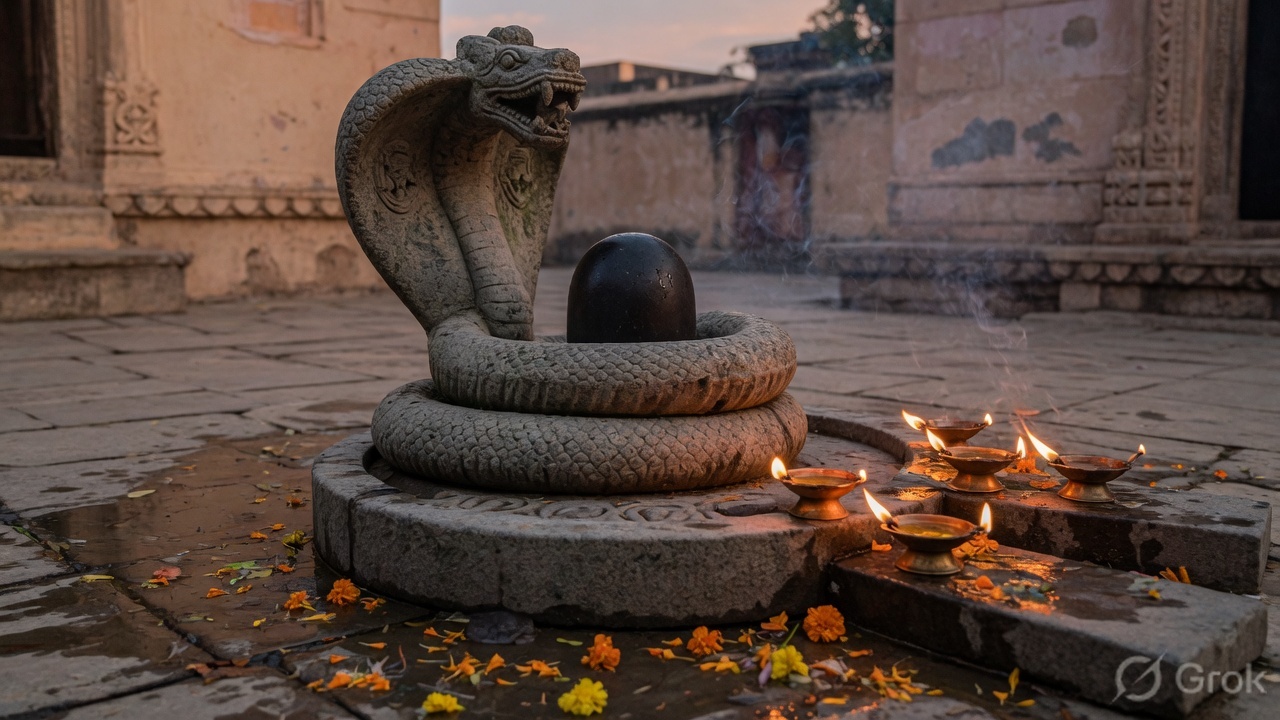
Where a family wishes to mark the yoga with a vidhi, the tradition that has grown around this name prescribes a Kaal Sarp Shanti — often a Rudrabhishek, a Nag puja, Rahu–Ketu mantra japa, and daan. Trimbakeshwar near Nashik is the centre most often named for this; Ujjain and Kalahasti are named too. The vidhi is an act of prayer and composure. It is not a transaction that edits a birth chart. Rahu and Ketu do not move because a havan was performed. A Shanti that is offered as a mechanism — 'do this and the obstruction lifts' — is being offered on grounds the chart cannot support.
The parts of the vidhi, where it is undertaken
- Sankalp — the statement of intention, naming the person, the place, the day and the purpose.
- Nag puja or a worship of Shiva in the form the kshetra keeps, since the naga and Rudra are the deities this later tradition addresses.
- Japa — the mantras of Rahu and Ketu, in the count the officiant prescribes for this pair.
- Havan — the fire offering, customarily a tenth of the japa.
- Daan — as the household's means allow; silver, black cloth, sesame, and food given without advertisement.
Nag Panchami is a natural calendar day for a household that already keeps it. A Shanti does not have to wait for that tithi, and it should not be rushed to a date chosen only because a report created panic. The tithi comes from the Panchang and from the family's capacity to be present, not from fear of the name.
None of this is a substitute for reading the rest of the chart. A delay that belongs to Shani, a matching question that belongs to Mangal, or a health question that belongs to a doctor will not become a Kaal Sarp question because the axis is present. Mixing those subjects is how a family spends a year on the wrong puja.
Why an accurate birth time matters
The Lagna changes roughly every two hours. Rahu and Ketu move slowly, so their signs are rarely in doubt from the date alone. The houses they occupy — and therefore which of the twelve names a report will print — follow from the Lagna. Two hours' error can move Rahu from the first house to the twelfth, rename Anant as Sheshnag, or open an enclosure that was never closed. A 'Kaal Sarp' printed from a rounded birth time of 'about sunrise' is a guess wearing a label.
When the birth time is not known
- A birth certificate, hospital record or municipal register is the most reliable source.
- Family memory narrowed to a window beats a round figure settled on for convenience.
- Where the time is lost, the signs of Rahu and Ketu can still be known from the date; the houses cannot.
- Rectification from known events produces an estimate, and should be called one. A yoga that depends on houses should not be declared from an estimate as if it were certain.
What a reading needs from you
For a consultation on this, three things are needed: the date of birth, the time of birth as precisely as it is known, and the place of birth. Without an accurate birth time the houses of the nodes are uncertain, and every conclusion drawn from those houses — the twelve names included — is uncertain with them.
What to prepare beforehand
- The place of birth given as town or village, not district.
- The source of the birth time, and how certain it is.
- Any earlier report that named a type, so the reference point it used can be checked.
- The question actually being asked: 'is the yoga present' and 'why has this particular delay occurred' are different questions, and only the second one is usually worth the hour.
Questions people ask
Does Kaal Sarp Dosh mean life will not move?
No. The popular reading describes a pressure along the Rahu–Ketu axis, not a halt. Charts with a complete enclosure belong to people whose work, family and practice have moved, often slowly and then all at once. No responsible reading treats the name as a prediction that nothing will happen.
Can Kaal Sarp Dosh be removed?
The word the later tradition uses is shanti — settling — not removal. A chart records a moment that has already occurred. Rahu and Ketu do not leave their places because a vidhi was performed. A Shanti is a prayer offered alongside a life, not an edit of the page it was written on.
Is a partial Kaal Sarp the same thing, only weaker?
No. If a graha sits outside the axis, the enclosure is not complete. Calling that a milder dose of the same yoga hides the planet that is free, which is often the planet the reading should start with.
Do the twelve types each have a separate fate?
They name a pair of houses. The fate, if the word must be used, is the rest of the chart: dignity, dasha, the Lagna, the Moon. Two people with the same type and different dashas are not living the same year.
Must the Shanti be done only at Trimbakeshwar?
Trimbakeshwar is the kshetra most associated with this later vidhi, and families who can go, go. It is not the only place a Rudrabhishek or a Nag puja can be offered with shraddha. A journey undertaken in panic, without a reading, is not made correct by the fame of the temple.
Is this the same as Sade Sati or Mangal Dosh?
No. Sade Sati is a transit of Shani from the natal Moon. Mangal Dosh is a natal placement of Mangal in certain houses, examined especially in matching. Kaal Sarp is a statement about the Rahu–Ketu axis at birth. They can coincide in one chart. They are not interchangeable names for 'something is wrong'.
Share the service and a preferred date. You will get a WhatsApp message to confirm. No account needed.
Book ConsultationRelated
Read next
 Karwa Chauth in Dubai 2026 — moonrise in GST, a Thursday fast that will actually finishKarwa Chauth 2026 in the UAE is Thursday 29 October. Sargi before a working day, puja after Dubai sunset, moonrise around 8:25 pm GST — and why a Delhi screenshot will keep you waiting past the moon.Read the article
 Dussehra in Dubai 2026 — Vijayadashami, Ayudha Puja, and a Tuesday that will actually finishVijayadashami 2026 in the UAE is Tuesday 20 October. Vijay muhurat in GST, Ayudha Puja on the 19th, visarjan without a river, and why a working Tuesday is still a complete Dashami.Read the article
 Love marriage in the kundli — the fifth house, Shukra, and what matching still has to doHow love and marriage are actually read from the fifth and seventh houses, what internet 'love marriage yog' claims about Rahu, why Gun Milan still applies, and what a delay is not.Read the article