
Krishna Janmashtami 2026 — why the date splits, and what the midnight puja actually is
Published: 3 September 2026 · Acharya Krishna Kant Shrimukh Shandilya Ji Maharaj · 7 min read
Krishna Janmashtami is the observance of Krishna's birth at midnight, on the Ashtami of the dark fortnight in Bhadrapada, when the Moon is in Rohini. In 2026 the calendar date most of India will print is Friday, 4 September. The Nishita Kaal puja — the window that stands in for the moment of birth — falls around midnight, and in several cities that window only opens after the clock has already moved into 5 September. That is why two honest panchangs can look as if they disagree. They are naming different parts of the same night.
I write this the day before the festival, because that is when the question arrives: is it the 3rd or the 4th, do we fast through Friday, when do we break the vrat, and does a family in London keep Delhi's midnight or their own. The answers are practical. They are also the difference between a night of worship and a night of argument over a screenshot.
The 2026 date, stated plainly
For most households and most North Indian calendars this year, Janmashtami is Friday, 4 September 2026. The Ashtami tithi, on the panchang I am using as the working reference, begins in the early hours of the 4th (around 2:25 a.m.) and ends just after midnight into the 5th (around 12:13 a.m.). Rohini Nakshatra runs through the 4th. Because Krishna's janma is traditionally marked at Nishita — the Hindu midnight, which is not twelve o'clock on a phone — the main puja sits at the end of the 4th and, in Delhi, Mumbai, Pune and several other cities, crosses into the first hour of the 5th.
Dahi Handi, the Maharashtrian recreation of the childhood stealing of butter, is kept the next day: Saturday, 5 September 2026. Nandotsav, the rejoicing in Nanda's household, is also the 5th. These are not a second Janmashtami. They are the morning after the birth.
Why some calendars still say 3 September
A smaller set of almanacs, and some Smarta rulings in some years, look at whether Ashtami and Rohini are both present at the local midnight of 3–4 September. If they are, that night can be named Janmashtami. ISKCON and many Vaishnava temples apply a stricter rule and wait for the tithi that covers Nishita on the following night. In 2026 the public confusion is exactly this fork. It is not that one side cannot count. It is that two classical conditions — Ashtami tithi, and Rohini at Nishita — do not always sit inside the same civil date in every city.
I do not treat this as a fight to be won on WhatsApp. A household should follow the panchang of the temple or the family priest they already trust, and then keep the whole night consistent: the fast, the jhula, the midnight aarti, the parana the next morning. Mixing a Thursday fast with a Friday midnight because two websites disagreed is how the vrat is broken by accident.
Nishita Kaal is local, not national
Nishita is calculated from local sunset and sunrise. That is why Kolkata can finish the birth puja before midnight on the 4th, while Mumbai's listed window is about 12:14 a.m. to 1:01 a.m. on the 5th, and Delhi sits across 11:57 p.m. on the 4th into 12:43 a.m. on the 5th. The festival date remains 4 September. The clock on the puja does not. Families who try to 'do it at 12:00 everywhere' are using a railway timetable for a lunar midnight.
If you are keeping the vrat outside India, use a panchang computed for your city — or, if you follow a particular matha or ISKCON centre, use theirs. Do not import Delhi's minute-hand and then wonder why Rohini has already ended.
What the night is for
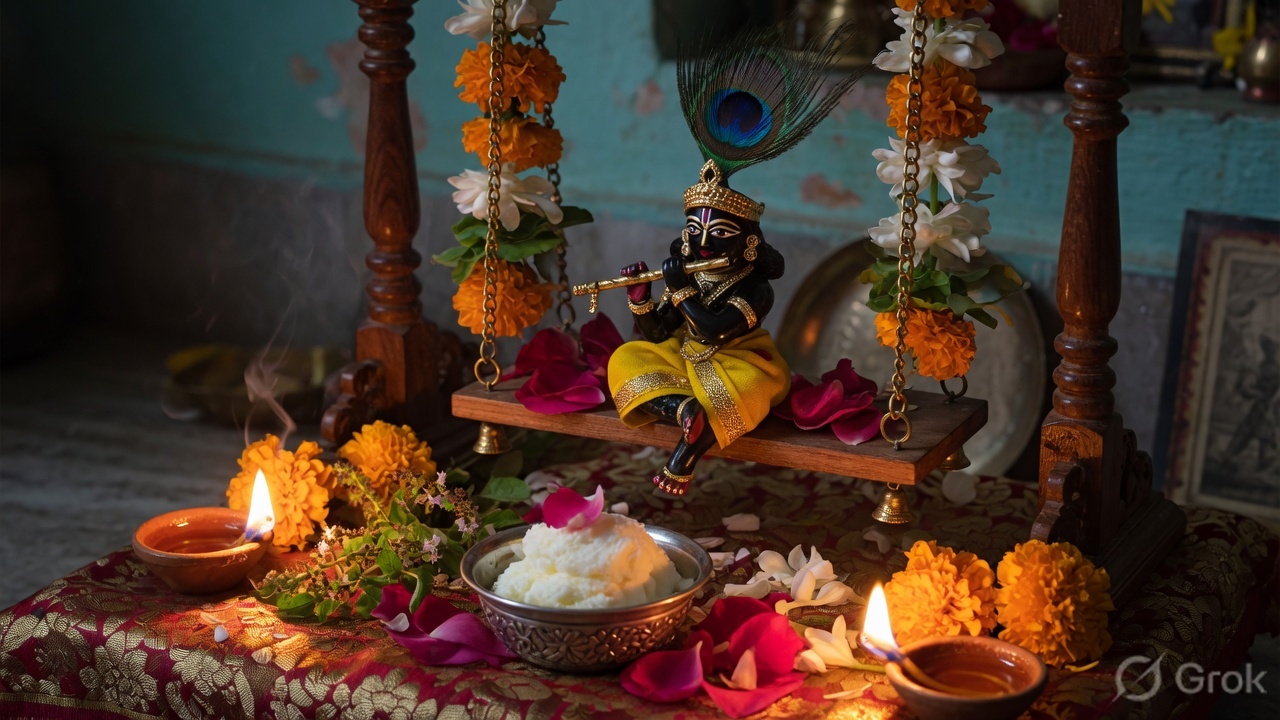
The Bhagavata Purana places the birth in a prison in Mathura, at midnight, in Rohini, while the rains are heavy and Kamsa's guards are asleep. The festival is not a birthday party in the modern sense. It is the keeping of that hour: the house made ready, the child-form of Krishna placed on a swing, the singing through the evening, the fast until the midnight aarti, then the offering of butter, mishri, and the food the household has prepared as bhog.
The jhula is not decoration. It is the seat of the janma. Keep it clean, raised, and not used as a shelf for phones. Tulsi, if the house has a plant, is the leaf of this night. The abhishek — water, milk, curd, honey, ghee, in the order the family already knows — is done before the midnight aarti, not after people have started eating.
The vrat, without theatre
Those who keep a full fast take only water, or fruit, or a single satvik meal according to the niyam they accepted in the morning sankalp. The parana — breaking the fast — is after sunrise on the 5th, once Ashtami has ended, not at the moment the aarti finishes if the tithi is still running. A vrat broken at 12:40 a.m. because the aarti felt like the end of the night is a vrat broken on Ashtami.
Pregnant women, the ill, children, and anyone whose physician has forbidden a fast should not be bullied into one. The shastra of this night is remembrance, not endurance for display. Offer the bhog, sit through the kirtan, keep the house from becoming an argument. That is the niyam most households actually need.
What I am asked as a jyotishi on this night
Janmashtami is not, in the texts I use, a personal muhurat for launching a company or a court case. It is a jayanti. The Moon in Rohini, Krishna as the child, the dark fortnight — these are conditions of the festival, not a blanket green signal for every sankalp a family has been postponing. If you want a muhurat for a katha, a naming, or a griha pravesh, that is a separate reading from the natal chart and the panchang of that work. Do not collapse them into 'it is Janmashtami, so everything is auspicious.'
What the night does support, without a chart, is the sankalp of bhakti: a kirtan, a reading of the tenth skandha, the first lesson of the Gita for a child, the lighting of the akhand deep if the house can keep it safely. Those acts do not require my profession. They require a clean corner and the decision to stay awake.
Mathura, Vrindavan, and a living room abroad
In Mathura and Vrindavan the janma is public — temple abhishek, jhanki, the streets. In Maharashtra the next morning is Dahi Handi, which is a civic festival with its own risks, and I will not romanticise a human pyramid that injures people. At home, including in apartments in London or New Jersey, the same night is a jhula, a fast, a recording of a bhajan, and a plate of butter. The shastra does not grade these. A Krishna who can be born in a prison does not require a marble mandir to be welcomed.
A simple vidhi that a household can finish
- Morning sankalp: name, gotra if known, the vrat, the intention of sitting through Nishita.
- Bathe, clean the shrine, place the murti or the photograph on the jhula, flowers and tulsi.
- Evening bhajan or a reading of the birth narrative from the tenth skandha.
- Abhishek before midnight, then vastra, chandan, the swing.
- Nishita aarti in the local window, bhog of butter, mishri, fruit, and whatever satvik food was cooked.
- Parana after sunrise on the 5th, once the tithi has ended.
- The 5th as Nandotsav: a lighter meal, the jhula left up through the day if the house can.
Questions people ask this week
Is Janmashtami 2026 on 3 September or 4 September?
For most of India, Friday 4 September. Some Smarta listings use the previous midnight. Follow one panchang for the whole vrat. The Nishita puja in many cities is after midnight, on the civil date 5 September, without moving the festival off the 4th.
When do we break the fast?
After sunrise on 5 September, when Ashtami has ended. Not at the aarti if the tithi is still running.
Can I keep it if I have to work on Friday?
Yes. Keep a fruit vrat, do the jhula in the evening, and join the midnight aarti even if it is a recording from the temple you trust. The night is not cancelled by a shift.
Does a janmashtami puja remove a dosh in the chart?
No. It is a jayanti. Charts are not edited by festivals. If you have a question about a dasha or a matching, that is a consultation on another day, with the birth details, not a midnight shortcut.
We are two time zones apart in the family. Whose midnight?
Each house keeps the local Nishita, or the midnight of the temple they have already chosen. Trying to make one Zoom aarti land on both midnights will miss both.
Share the service and a preferred date. You will get a WhatsApp message to confirm. No account needed.
Book ConsultationRelated
Read next
 Karwa Chauth in Dubai 2026 — moonrise in GST, a Thursday fast that will actually finishKarwa Chauth 2026 in the UAE is Thursday 29 October. Sargi before a working day, puja after Dubai sunset, moonrise around 8:25 pm GST — and why a Delhi screenshot will keep you waiting past the moon.Read the article
 Dussehra in Dubai 2026 — Vijayadashami, Ayudha Puja, and a Tuesday that will actually finishVijayadashami 2026 in the UAE is Tuesday 20 October. Vijay muhurat in GST, Ayudha Puja on the 19th, visarjan without a river, and why a working Tuesday is still a complete Dashami.Read the article
 Love marriage in the kundli — the fifth house, Shukra, and what matching still has to doHow love and marriage are actually read from the fifth and seventh houses, what internet 'love marriage yog' claims about Rahu, why Gun Milan still applies, and what a delay is not.Read the article