
Mangal Dosh — a matter for reflection, not fear
Published: 10 August 2026 · Acharya Krishna Kant Shrimukh Shandilya Ji Maharaj · 7 min read
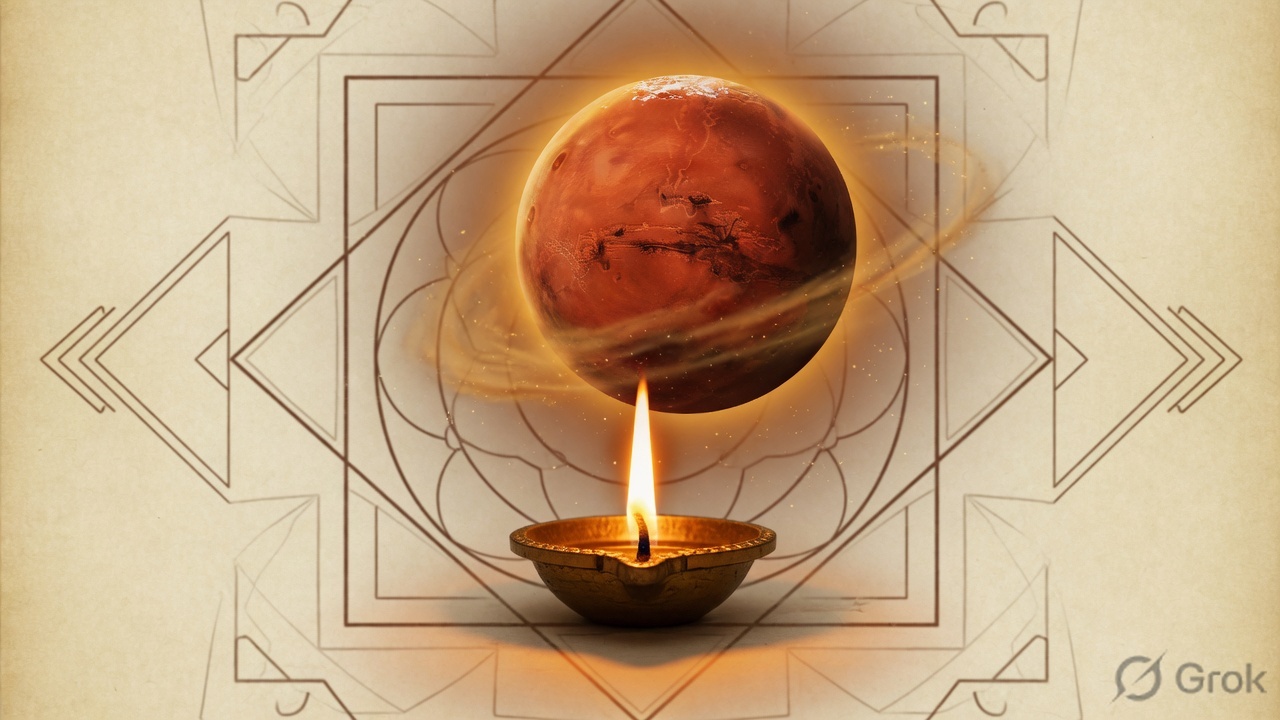
In the Jyotish tradition, Mangal Dosh — also called Kuja Dosh or Manglik Dosh — refers to Mangal occupying the first, fourth, seventh, eighth or twelfth house counted from the Lagna. Classical texts associate these placements with a forceful, impatient temperament, and traditionally they are examined closely when two horoscopes are being matched for marriage. The same texts record an equally long list of parihar — conditions under which the placement is held to be settled — so a careful reading begins by establishing whether the dosh applies at all, rather than by assuming that it does.
Which houses are counted, and why each is read differently
The five houses are not interchangeable. Mangal is the karaka of energy, courage and haste, and what a placement bears upon follows from the affairs its house governs.
- First, the Lagna — the body and temperament; force turned inward on one's own manner.
- Fourth — the home, domestic peace, the mother: a household's atmosphere, not the marriage.
- Seventh — the spouse and every partnership; examined most closely in matching.
- Eighth — longevity, inheritance, sudden turns; here the texts are most cautious.
- Twelfth — expenditure, private life, distance from home; restlessness more than conflict.
Some schools count the second house too, as the house of kutumb and of speech — a difference between traditions, not carelessness, and worth knowing before two readings are set against each other.
Lagna, Chandra or Shukra — why two readings disagree
Houses are counted from a reference point, and the tradition offers more than one. From the Lagna is the most widespread. From the Chandra — the Moon's sign taken as the first house — is standard in much of the classical literature, the Moon being the seat of the mind. From Shukra, karaka of marriage, is a third convention used for this question.
They need not agree. Some treat the dosh as significant only when it shows from two of the three; others weight the Lagna and take the rest as confirmation. A family told three different things by three astrologers has often been told the truth three times, from three starting points.
The exceptions the same texts record
What is rarely said alongside this is how many exceptions the same texts record. Mangal in its own sign or in its sign of exaltation, Mangal aspected by Guru, a comparable placement in the other person's chart, and several placements read from the Moon rather than the Lagna are all treated in the classical literature as parihar — conditions under which the dosh is considered settled. A chart is read whole. A single placement, isolated from the rest of it, is not a reading.
Mangal in dignity
Mesh and Vrishchik are its own signs, Makar its exaltation. A graha in dignity acts on its own terms rather than under strain, and reads far less troubling than the same house held in an uncomfortable sign.
The drishti of Guru
Guru brings deliberation to a graha whose fault is haste. Where Guru aspects Mangal or sits with it, the placement is widely held settled — the steadiest single mitigation the texts record.
The view based on age
A widely cited traditional view holds the placement carries less weight after about twenty-eight. It is a mitigating consideration, not a rule, and worth stating because families are often told the opposite.
Why the word arrives before the meaning
This matters because the word travels faster than the meaning. Families arrive having heard only that someone is 'Manglik', with no idea whether the placement in question is even one that the tradition treats as significant in their case. The first thing a consultation usually does is establish whether there is anything here to discuss at all.
Gun milan and Mangal Dosh are two separate assessments
The Ashtakoot method that yields the familiar score out of thirty-six compares the Moon's Nakshatra and sign across eight koots — Varna, Vashya, Tara, Yoni, Graha Maitri, Gana, Bhakoot and Nadi.
Mangal Dosh is not one of the eight: it neither adds to that score nor is deducted from it. Charts can score well and still carry the placement, or score modestly and raise no Mangal question at all. 'The gunas did not match because he is Manglik' describes something that cannot happen.
Misconceptions worth correcting plainly
'A Manglik must marry a Manglik'
A matching placement is one parihar among several — sufficient where present, not necessary in its absence. Treated as a rule, it narrows a family's search drastically on the strength of half a verse.
Kumbh Vivah and similar customs
A symbolic marriage to a tree, a pot or an image beforehand is a regional folk custom, not a vidhi with broad shastric standing. Where a family keeps it as their own, that is theirs; but no one should be told a marriage cannot take place without it.
'The dosh is a life sentence'
Nothing in the classical material describes it as permanent, or as a verdict on anyone's character or future. It is one factor in a chart containing many, several of which the texts weigh more heavily.
What Mangal Shanti is, and what it is not
Where the placement is significant, the tradition prescribes Mangal Shanti — a Shanti Puja addressed to Mangal, performed on a suitable tithi, generally involving the Mangal mantra japa, a havan, and the daan appropriate to the graha. It is understood as an act of composure and prayer, not as a transaction that alters a chart. The purpose is the state of mind the person brings to the decision in front of them.
The parts of the vidhi
- Sankalp — the statement of intention, naming person, place, day and purpose.
- Japa — the mantra of Mangal, Vedic or Pauranik, in the count prescribed for this graha.
- Havan — the fire offering, customarily a tenth of the japa, with Mangal's samidha and dravya.
- Daan — red lentils, copper, red cloth, gur, as the household's means allow.
Mangalwar is the natural weekday, and Mrigashira, Chitra and Dhanishtha the Nakshatras of Mangal; the tithi comes from the Panchang, not from convenience. None of it is a mechanism: a Shanti does not move a graha, cure an illness or settle an outcome, and should never be offered on those grounds.
Why an accurate birth time matters
The Lagna changes roughly every two hours. Mangal spends about six weeks in a sign, so its sign is rarely in doubt — but its house follows from the Lagna, and the house is the whole of this question. Two hours' error can create a dosh where there is none, or erase one that is there.
When the birth time is not known
- A birth certificate, hospital record or municipal register is the most reliable source.
- Family memory narrowed to a window beats a round figure settled on for convenience.
- Where the time is lost, a Chandra kundli can still be drawn from the date, the Moon changing sign only every two and a quarter days. That supports the reading from the Moon, not from the Lagna.
- Rectification from known events produces an estimate, and should be called one.
What a reading needs from you
For a consultation on this, three things are needed: the date of birth, the time of birth as precisely as it is known, and the place of birth. Without an accurate birth time the Lagna itself is uncertain, and every conclusion drawn from it — Mangal Dosh included — is uncertain with it.
What to prepare beforehand
- The place of birth given as town or village, not district.
- The same three details for the other person, where the question is one of matching.
- The source of the birth time, and how certain it is.
- Any earlier reading, and which reference point it used.
- The question actually being asked: 'is there a dosh' and 'should this marriage proceed' are different questions.
Questions people ask
Does Mangal Dosh mean a marriage will fail?
No. The tradition describes a temperament to be aware of, not an outcome to expect. No classical text treats the placement as a prediction of failure.
Can Mangal Dosh be removed?
The word the texts use is shanti — settling — not removal. A chart records a moment that has already occurred, and it is not edited afterwards.
Do both charts need to be examined?
Both. Several of the recorded parihar depend on what the other chart contains, so a matching question cannot be answered from one horoscope.
Is a marriage between a Manglik and a non-Manglik forbidden?
No text forbids it. The matching placement is one exception among many, and its absence is not in itself an obstacle.
Share the service and a preferred date. You will get a WhatsApp message to confirm. No account needed.
Book ConsultationRelated
Read next
 Karwa Chauth in Dubai 2026 — moonrise in GST, a Thursday fast that will actually finishKarwa Chauth 2026 in the UAE is Thursday 29 October. Sargi before a working day, puja after Dubai sunset, moonrise around 8:25 pm GST — and why a Delhi screenshot will keep you waiting past the moon.Read the article
 Dussehra in Dubai 2026 — Vijayadashami, Ayudha Puja, and a Tuesday that will actually finishVijayadashami 2026 in the UAE is Tuesday 20 October. Vijay muhurat in GST, Ayudha Puja on the 19th, visarjan without a river, and why a working Tuesday is still a complete Dashami.Read the article
 Love marriage in the kundli — the fifth house, Shukra, and what matching still has to doHow love and marriage are actually read from the fifth and seventh houses, what internet 'love marriage yog' claims about Rahu, why Gun Milan still applies, and what a delay is not.Read the article