
Pitra Dosh — how the ninth house is read, and what Shraddh actually is
Published: 18 September 2026 · Acharya Krishna Kant Shrimukh Shandilya Ji Maharaj · 8 min read
Pitra Dosh — also written Pitru Dosh — is the name given when a chart is read as carrying an obstruction in the pitru sthana: most often the ninth house, Surya as karaka of the father and the paternal line, or Rahu sitting with either. Families arrive having been told that the ancestors are unhappy, that marriage and children will wait until a Gaya pind daan is done, and that a free online report which printed the word has already decided the matter. The ninth house is real. The rest of that sentence is not a reading.
I am writing this on 18 September 2026, eight days before Pitru Paksha opens. In 2026 the fortnight runs from Purnima Shraddha on Saturday 26 September through Sarva Pitru Amavasya — Mahalaya Amavasya — on Saturday 10 October. Sharad Navratri begins the next morning. This is the window in which the search for the word spikes, in India and in the Gulf, and it is also the window in which a family can still choose a tithi rather than panic into the first booking a website offers.
How the chart is actually looked at
The ninth house is the pitru sthana — dharma, the father, the teachers, and what is inherited that is not money. Surya is the karaka of the father and of the paternal line. Rahu with the ninth, with its lord, or with Surya is the combination most reports print as Pitra Dosh. Shani afflicting the same places is read as delay and unfinished obligation rather than as a serpent or a curse. Guru, karaka of the pitris in another strand of the same literature, is looked at too: his dignity or his trouble changes the sentence.
Two details the reports skip. First, a chart is read whole. A ninth house under pressure with a strong Lagna, a well-placed Guru and a supportive dasha is not the same life as a ninth house under pressure in a weak chart in a Rahu dasha. Second, without an accurate birth time the Lagna itself is uncertain, and every house counted from it — the ninth included — moves with it. A 'Pitra Dosh' printed from a rounded time of 'about sunrise' is a guess wearing a label.
What the word is taken to describe — and what it is not
Where the combination is significant, the popular reading is of delay that does not explain itself: a marriage that does not settle, a lineage question that keeps returning, a sense that something inherited has not been taken up. The tradition's own language for this is shraddh — faithful offering — not punishment. Ancestors are remembered. They are not billed.
The same chart may contain a strong ninth lord, a Surya in dignity, a dasha of Guru. Those facts do not disappear because a report found Rahu. Collapsing every delay in a family into Pitra Dosh is how the word travels faster than the meaning, and how a household spends a year on the wrong puja.
Annual Shraddh, tarpan, Tripindi — three different acts
They are spoken as if they were one. They are not.
- The annual Shraddh is kept on the tithi of the parent's passing, every year, usually in Pitru Paksha if that is the family's custom, or on the death anniversary. It is the ordinary remembrance. Most houses that 'have Pitra Dosh' on a website have simply let this lapse for a generation.
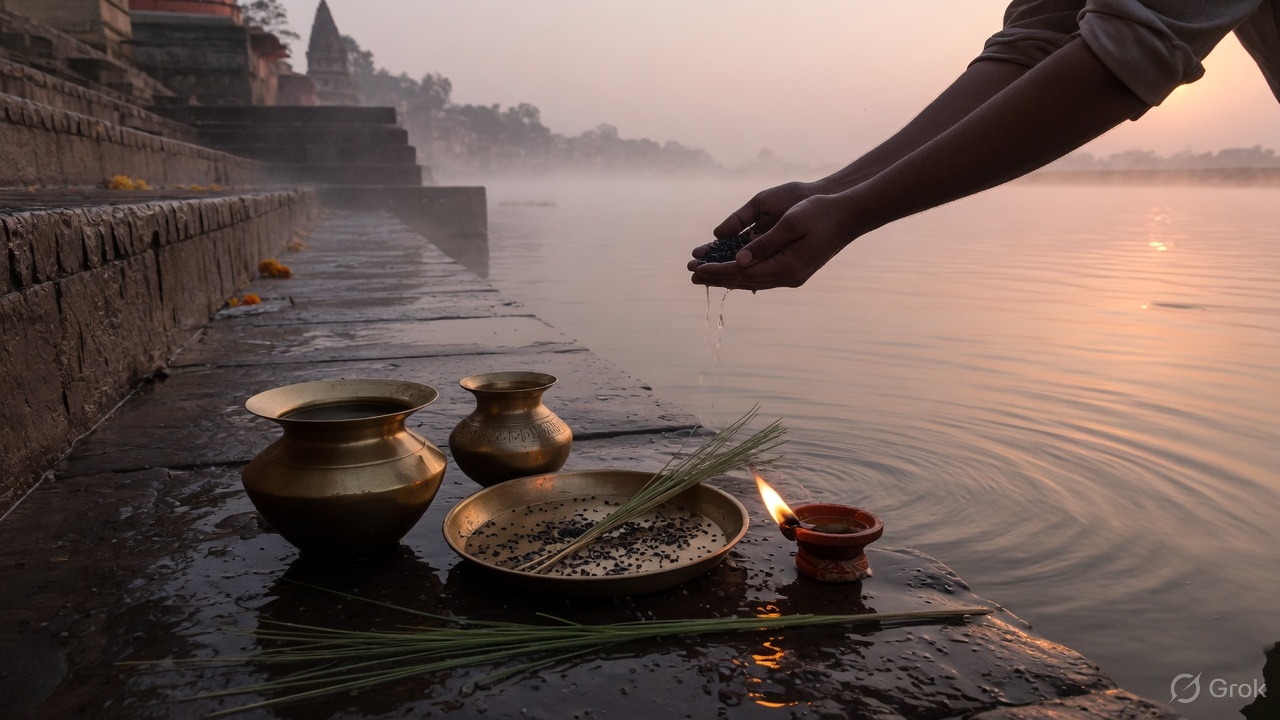
- Tarpan is the offering of water, sesame and a blade of kusha, done on the tithi, at a river if one is near, at home if one is not. It is the daily-scale act of the fortnight, not a replacement for the annual Shraddh and not a temple package.
- Tripindi Shraddh is the rite prescribed where the annual offering has been left undone across generations, or where a death was untimely, or the antyeshti incomplete, or the names themselves lost. It is offered for the lineage rather than for one named ancestor. It is a separate article on this site, and a separate booking. It is not the first thing a family needs because a report printed a word.
A household that still keeps the annual Shraddh, even simply, is already doing the act the texts put first. Buying a more expensive rite because the cheaper one felt insufficient is not shastra. It is fear with a receipt.
Pitru Paksha 2026 — the dates that matter this year
Panchang varies by city by a few hours; the civil dates below are the ones in wide use for North India this year. Confirm the tithi for your town, or for Dubai if that is where you will sit, before you lock a day.
- Saturday 26 September 2026 — Purnima Shraddha, the opening.
- Sunday 27 September — Pratipada Shraddha; for many families the first day of the Krishna-paksha sequence.
- Tuesday 29 September — Tritiya, and Maha Bharani in many panchangs.
- Sunday 4 October — Navami / Matri Navami, kept especially for mothers and for married women of the line who died as suhagins.
- Wednesday 7 October — Dwadashi, and Magha Shraddha in many lists.
- Friday 9 October — Chaturdashi, traditionally named for those who died untimely.
- Saturday 10 October 2026 — Sarva Pitru Amavasya, Mahalaya. If the death tithi is not known, or several ancestors are to be remembered on one day, this is the day the tradition gives you. Navratri begins on the 11th.
Aparahna — the afternoon watch — is the window most paddhatis prefer for the offering. Morning panic is not a substitute for that window. If you are sitting in Dubai, GST is one and a half hours behind IST: an Aparahna that begins mid-afternoon in Sultanpur is still afternoon in Dubai, not evening, and a family can sit without waiting for midnight India time.
What a family living abroad can actually do
Gaya, Haridwar, Prayagraj and the family's village remain the kshetras named for pind daan. A household in Dubai, Sharjah or Abu Dhabi cannot always travel in this fortnight, and should not be told that nothing counts unless they do. The annual Shraddh can be kept in the house: a clean seat, the name and gotra as they are known, water, sesame, a lamp, food given without advertisement. Where the names are lost, Sarva Pitru Amavasya is the day the texts already provided for that loss.
A consultation from abroad needs the same three facts as one from the next district: date of birth, time as precisely as it is known, place of birth as town or village. WhatsApp carries the sankalp and the tithi. A Tripindi or a larger shanti, if it is actually indicated, can be performed in India on the family's behalf with the sankalp taken in their names — that is an old arrangement, not a modern shortcut. What it is not is a mechanism that edits the ninth house from a distance.
Why an accurate birth time matters here too
The Lagna changes roughly every two hours. Surya and Rahu move slowly enough that their signs are rarely in doubt from the date. The houses they occupy — and therefore whether a report will print 'ninth house' at all — follow from the Lagna. Two hours' error can move Rahu from the ninth to the eighth, or open a ninth that was never closed. Ask for the source of the time before anyone names a dosh.
What a reading needs from you
- Date, time and place of birth, with how certain the time is.
- Whether the annual Shraddh has been kept, and for whom, as far as the family knows.
- The gotra if it is known; if it is not, say so, rather than inventing one for the form.
- Where you will sit for the fortnight — a village in India, a flat in Dubai — because the tithi is local to the sky you are under.
- The question actually being asked. 'Is there Pitra Dosh' and 'we have not kept Shraddh since the grandfather died' are different questions. The second one is usually the one worth the hour.
Questions people ask
Does Pitra Dosh mean the ancestors are angry?
No. The classical language is of offering and remembrance, not of anger. A report that sells fear is not reading a chart. It is writing a caption.
Can Pitra Dosh be removed?
The word the tradition uses is shanti — settling — not removal. A chart records a moment that has already occurred. Shraddh is an act done alongside a life, not an edit of the page it was written on.
We live in Dubai. Must we go to Gaya this fortnight?
Gaya remains the kshetra most named for pind daan, and families who can go, go. A household that cannot travel is not barred from the annual offering. Keep it where you are, on the tithi, with what the house can give. A journey undertaken only because a website created panic is not made correct by the fame of the tirtha.
Is this the same as Tripindi Shraddh?
No. Tripindi is the special rite for a lapse across generations, an untimely death, or names that were lost. Pitra Dosh is a chart-reading. The annual Shraddh is the ordinary act. They can coincide. They are not interchangeable names for 'something is wrong with the family'.
If the death tithi is not known, which day do we keep?
Sarva Pitru Amavasya — 10 October 2026 this year. That is what the day is for.
Is a marriage delayed because of Pitra Dosh?
Delay has many houses. The seventh, Shukra, Mangal, the dasha running, and the other person's chart all speak before a ninth-house label should. A matching question is not answered by this word alone.
Share the service and a preferred date. You will get a WhatsApp message to confirm. No account needed.
Book ConsultationRelated
Read next
 Karwa Chauth in Dubai 2026 — moonrise in GST, a Thursday fast that will actually finishKarwa Chauth 2026 in the UAE is Thursday 29 October. Sargi before a working day, puja after Dubai sunset, moonrise around 8:25 pm GST — and why a Delhi screenshot will keep you waiting past the moon.Read the article
 Dussehra in Dubai 2026 — Vijayadashami, Ayudha Puja, and a Tuesday that will actually finishVijayadashami 2026 in the UAE is Tuesday 20 October. Vijay muhurat in GST, Ayudha Puja on the 19th, visarjan without a river, and why a working Tuesday is still a complete Dashami.Read the article
 Love marriage in the kundli — the fifth house, Shukra, and what matching still has to doHow love and marriage are actually read from the fifth and seventh houses, what internet 'love marriage yog' claims about Rahu, why Gun Milan still applies, and what a delay is not.Read the article