
Sade Sati of Saturn — what the 7.5 years actually are
Published: 12 September 2026 · Acharya Krishna Kant Shrimukh Shandilya Ji Maharaj · 10 min read
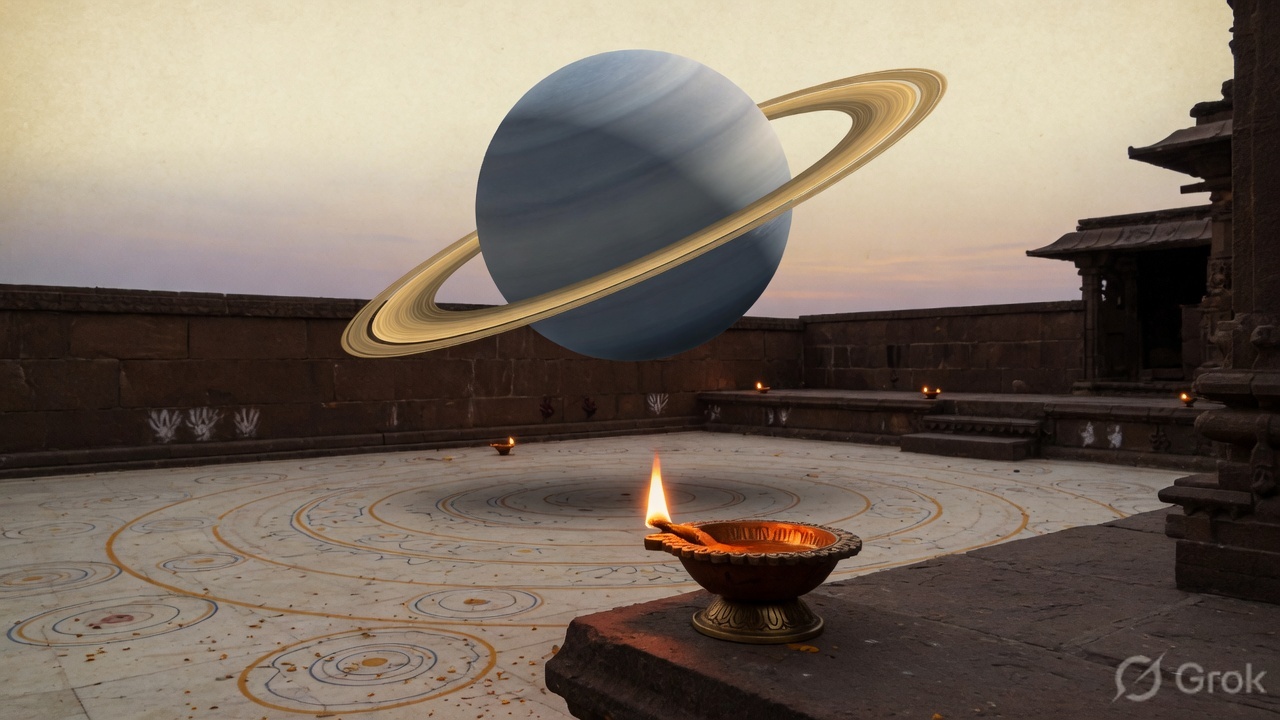
Sade Sati is the period in which Shani — Saturn — transits the twelfth, first and second houses counted from the Moon in a birth chart. The name is Hindi for seven and a half: Saturn takes about two and a half years to cross one sign, and three signs make seven and a half. It is one of the most searched phrases in Jyotish, in India and among families living abroad, and it is also one of the most poorly explained. People arrive having been told that seven and a half years of misfortune are about to begin. The classical material describes a transit of a slow graha across the Moon's neighbourhood. Those are not the same statement.
I write this as someone who reads charts for this question every week. The purpose is not to empty the subject of gravity, and not to sell a remedy. It is to put the counting, the three phases, the conditions under which the period is held to be heavy or light, and the limits of what a Shanti can be asked to do, in one place a family can actually use.
How Sade Sati is counted
The reference point is the natal Moon — the sign the Moon occupied at birth — not the Lagna, not the Sun, and not the calendar year. Saturn's transit is watched against that sign. When Saturn is in the sign immediately before the Moon's sign, the rising phase has begun. When Saturn occupies the Moon's own sign, the peak phase is running. When Saturn moves into the sign immediately after, the setting phase is underway. When Saturn leaves that third sign, Sade Sati as this tradition counts it is over.
Because Saturn's mean motion is a little over two years per sign, the whole arc is close to seven and a half years. The exact dates for any person are taken from an ephemeris against their natal Moon sign, not from a newspaper column that names a rashi and a year. Two people born a fortnight apart can have different Moon signs, and therefore different Sade Sati windows, even if they share a birthday month.
Why the Moon, not the Lagna
The Moon is the karaka of the mind, of habit, of what a person feels before they have decided what to think. Saturn is the karaka of time, delay, labour, and the structures that do not yield to wishing. A transit of Saturn across the Moon's sign and its two neighbours is read as a pressure on that inner weather — on sleep, on morale, on the sense that effort is being asked for without an immediate return. The Lagna describes the body and the path through the world; Saturn's transit of the Lagna is a different question, and it is not Sade Sati.
This is why two people with Saturn transiting the same sign of the zodiac in a given year are not in the same period. One may have the Moon there; the other may have the Moon six signs away. The newspaper that says 'Sade Sati for Mesh rashi this year' is speaking of the Moon sign as if it were a sun-sign column. For a reading, the natal Moon of the person in the room is the only starting point that matters.
The three phases, and why they are not interchangeable
Rising — Saturn in the twelfth from the Moon
The twelfth from the Moon is associated with expenditure, with withdrawal, with sleep and with what is spent without remaining in the hand. Families often describe this phase as a draining of reserves — money, energy, or both — before they can name a single event. Classically it is the preparation, not the centre of the period. Work begun here tends to show its cost before it shows its fruit.
Peak — Saturn on the natal Moon
This is the phase most of the popular writing is about, and the one in which the Moon's own strength or weakness is most visible. A Moon that is well placed, waxing, and supported by Guru or by its own sign, tends to carry the same transit with more composure than a Moon that is waning, afflicted, or in an enemy's sign. The transit does not change; the ground it walks on does. People speak of heaviness, of delayed decisions, of a parent or a duty that will not be postponed. The texts do not promise disaster. They describe a demand for patience that cannot be negotiated down.
Setting — Saturn in the second from the Moon
The second from the Moon concerns speech, family resources, and what is accumulated. This phase is often the one in which earlier labour begins to take a visible shape — or in which the bill for what was spent in the twelfth comes due in a more ordinary way. It is not automatically 'relief'. It is the last of the three signs, and Saturn is still Saturn.
Sade Sati is not the same as Dhaiya
Dhaiya — two and a half years — is Saturn's transit of the fourth or the eighth from the Moon, counted separately. It is shorter, and it is not a portion of Sade Sati. Families sometimes use the two words as if they named one period. They do not. A person can be in Dhaiya without being in Sade Sati, and the reverse. A reading that confuses them will date the wrong window and prescribe the wrong composure.
Why two people born in the same year experience it differently
Saturn's sign in the sky is shared by everyone alive in that season. The natal Moon is not. Beyond that, three further things decide how a given Sade Sati is read in a chart.
The dignity of Saturn in the birth chart
Saturn in its own signs, Tula and Kumbha, or in exaltation in Tula according to the school one follows, or occupying a kendra with support, is not the same Saturn as one combust, debilitated, or hemmed by malefics. The transiting Saturn is one graha; the natal Saturn is the other half of the sentence.
The dasha running
A Sade Sati that falls inside a Saturn dasha, or a dasha of a graha tightly bound to Saturn, is read more closely than one that falls in a dasha that has little to do with him. Transit and dasha are two clocks. A reading that uses only one of them is half a reading.
The house Saturn occupies from the Lagna while all this is happening
Sade Sati is counted from the Moon. What Saturn is doing to the Lagna, the seventh, the tenth, at the same time, is a separate overlay. A peak phase that also sits on the tenth from Lagna is a vocational question as well as a lunar one. The two must not be collapsed into a single slogan.
Saturn return in Western astrology is a different count
Western astrology speaks of a Saturn return around the twenty-ninth year, when transiting Saturn comes back to its natal degree. That is a return to Saturn's own place. Sade Sati is a transit relative to the Moon. They can overlap in a life, and they often do in the late twenties, but they are not translations of each other. A family living abroad who has been told both phrases in two languages is usually being told two systems, not one fact twice. I say this because the confusion produces dates that do not match, and then a loss of trust in both.
What the period is associated with — and what it is not
Classically, Saturn's slow passage by the Moon is associated with labour that takes longer than expected, with duties to elders, with the thinning of easy optimism, and with the kind of growth that is visible only afterwards. It is also associated, in the popular mind, with death, ruin, divorce and disease as if these were scheduled. No classical text I rely on treats Sade Sati as a sentence of that kind. Charts in which those events occur during the period also contain other combinations; charts in which the period passes in ordinary difficulty are far more numerous. Fear travels faster than counting. A consultation that begins with fear will spend its hour undoing a rumour instead of reading a chart.
What a Shani Shanti is, and what it is not
Where the period is significant, the tradition prescribes a Shani Shanti — a Shanti addressed to Shani, performed on a suitable Saturday or on a tithi chosen from the panchang, generally involving the Shani mantra, oil and black sesame as daan, and a havan in the measure the family can keep with sincerity. It is an act of composure. It is not a transaction that shortens Saturn's stay in a sign. Saturn will leave that sign when the ephemeris says so, whether or not a puja has been done.
The parts of the vidhi, plainly
- Sankalp — naming the person, the place, the day and the purpose, so the act is not anonymous.
- Japa — the mantra of Shani, in a count the household can actually complete, not a number chosen for display.
- Daan — sesame, iron or black cloth, oil, as means allow. The measure is sincerity, not the catalogue.
- Havan — where it is done, a tenth of the japa is the customary proportion.
Shanivar is the natural weekday. None of this moves a graha. I will not offer a Shanti on the claim that it will. A family that wants a date, a vidhi and a clear account of what they are doing is in the right place. A family that wants a guarantee is not, and should be told so at the start.
Why the birth time still matters
Sade Sati is counted from the Moon's sign, and the Moon changes sign only every two and a quarter days, so a birth time that is wrong by an hour rarely moves the Moon sign. That is a relief, and it is also a trap. The overlay from the Lagna — which house Saturn occupies in the same years — does depend on the birth time, because the Lagna changes about every two hours. A Sade Sati reading that ignores the Lagna overlay is incomplete. A Sade Sati reading that uses a guessed Lagna is a guess with a Sanskrit name.
When the time is not known
- A hospital record or municipal register beats family memory.
- A window of a few hours is more honest than a round figure.
- The Moon sign can still be established from the date in most cases, which is enough to date the three phases, though not enough to read the Lagna overlay.
- Rectification from life events is an estimate, and I call it one.
What I need from you for a reading
Date of birth, time of birth as precisely as it is known, and place of birth as town or village, not district. If the question is 'when does it begin for me', the Moon sign and an ephemeris will answer most of it. If the question is 'how should I meet it', the rest of the chart has to come with it — dasha, natal Saturn, the Lagna. Those are different questions. Bring the one you actually have.
Questions people ask
Does Sade Sati mean seven and a half years of misfortune?
No. It means Saturn will occupy three signs around the natal Moon. What those years contain depends on the chart, the dasha, and the life already in motion. Misfortune is not a transit.
Can Sade Sati be cancelled?
Saturn's motion is not cancelled. What can be settled is the mind with which the period is met. That is the meaning of shanti in this context.
Is everyone in the same rashi in Sade Sati together?
Only those who share the natal Moon sign. Sharing a Western sun sign, or a Hindi newspaper rashi named from the Moon without a chart, is not the same thing.
Does a Shani Shanti shorten the period?
No. It does not alter an ephemeris. It is a vidhi of composure, and should be taken as one.
I live outside India. Does the counting change?
The sky does not. The natal Moon is the natal Moon in Lambhua and in London. The dates are taken from the same motion of Saturn. What changes is only where the sankalp is taken, and in which language the family asks the question.
Share the service and a preferred date. You will get a WhatsApp message to confirm. No account needed.
Book ConsultationRelated
Read next
 Karwa Chauth in Dubai 2026 — moonrise in GST, a Thursday fast that will actually finishKarwa Chauth 2026 in the UAE is Thursday 29 October. Sargi before a working day, puja after Dubai sunset, moonrise around 8:25 pm GST — and why a Delhi screenshot will keep you waiting past the moon.Read the article
 Dussehra in Dubai 2026 — Vijayadashami, Ayudha Puja, and a Tuesday that will actually finishVijayadashami 2026 in the UAE is Tuesday 20 October. Vijay muhurat in GST, Ayudha Puja on the 19th, visarjan without a river, and why a working Tuesday is still a complete Dashami.Read the article
 Love marriage in the kundli — the fifth house, Shukra, and what matching still has to doHow love and marriage are actually read from the fifth and seventh houses, what internet 'love marriage yog' claims about Rahu, why Gun Milan still applies, and what a delay is not.Read the article